
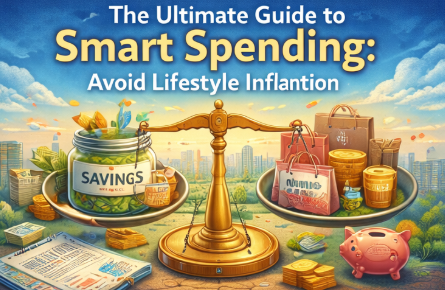
You got a raise. A promotion. A new client. Your income went up — but somehow, you're still living paycheck to paycheck. Sound familiar?
This is lifestyle inflation — the silent wealth killer — and the antidote is building good money habits that keep your spending in check. It happens when your spending rises in proportion to your income, leaving your savings rate unchanged. The fix? Set clear financial goals that give your raises a purpose, leaving your savings rate unchanged (or worse, declining) despite earning more money.
Lifestyle inflation is why people earning $150,000 per year can feel just as financially stressed as those earning $50,000. The problem isn't income — it's spending habits.
This guide teaches you how to practice smart spending, avoid lifestyle inflation, and ensure that every income increase actually builds wealth instead of funding bigger expenses.
What Is Lifestyle Inflation?
Lifestyle inflation (also called lifestyle creep) occurs when discretionary spending increases as income rises. Instead of saving or investing the difference, you upgrade:
- The apartment becomes a luxury condo
- The reliable car becomes a financed SUV
- Cooking at home becomes dining out 4 nights per week
- The $10/month gym becomes a $200/month boutique studio
- Basic clothing becomes designer brands
The Math That Matters
Consider two scenarios:
Person A: Earns $60,000. Spends $55,000. Saves $5,000/year. Person B: Earns $100,000. Spends $95,000. Saves $5,000/year.
Person B earns $40,000 more annually but saves the exact same amount. Over 20 years with compound interest, both accumulate similar wealth — despite Person B earning significantly more over their lifetime.
Lifestyle inflation is the reason high earners often retire with less wealth than moderate earners who maintain disciplined spending. The antidote is building good money habits that keep your spending aligned with your values, not your income.
Why Lifestyle Inflation Is So Dangerous
1. It's Invisible
Unlike a market crash or job loss, lifestyle inflation happens gradually. A slightly nicer apartment here, a few extra subscriptions there — individually harmless, collectively devastating.
2. It Resets Your Baseline
Once you upgrade your lifestyle, it becomes your new normal. Downgrading feels like deprivation, even though you were perfectly happy before the upgrade.
3. It Creates Financial Fragility
Higher fixed expenses (expensive rent, car payments, premium subscriptions) mean you need more income just to maintain your lifestyle. Job loss or income reduction becomes catastrophic.
4. It Delays Financial Independence
Every dollar spent on lifestyle upgrades is a dollar not invested. At an 8% return, a $500/month lifestyle upgrade costs you over $450,000 in potential wealth over 30 years.
The Smart Spending Framework
Smart spending isn't about deprivation. It's about intentionality — and it works best when paired with clear financial goals that give your money direction. Smart spending isn't about deprivation. It's about intentionality — directing money toward things that genuinely improve your life while cutting spending that doesn't.
The Core Principle
Spend deliberately on what you value. Cut ruthlessly on what you don't.
This means you can spend money on things you love — travel, hobbies, quality food — as long as you're intentional about it and not spending unconsciously across every category.
Step 1: Audit Your Current Spending
Before you can practice smart spending, you need visibility into where your money goes.
30-Day Spending Audit
- Track every expense for 30 days
- Categorize each expense:
- High-value — Genuinely improves your life or happiness
- Medium-value — Nice to have but not essential
- Low-value — Barely noticed or adds minimal satisfaction
- Calculate how much goes to each category
Most people discover 20–40% of their spending falls into the "low-value" category — expenses they wouldn't miss if eliminated.
Use Safe Spend to automatically track and categorize your spending, making it easy to identify low-value expenses draining your budget.
Step 2: Apply the 50% Rule for Raises
When your income increases, apply this formula:
- 50% of the increase → Savings, investments, or debt payoff
- 30% of the increase → Meaningful lifestyle improvements
- 20% of the increase → Fun money or short-term goals
Example
You receive a $6,000 annual raise ($500/month after tax):
- $250/month → Investing or debt payoff
- $150/month → Meaningful upgrade (better gym, meal delivery service)
- $100/month → Fun money (dining, entertainment, hobbies)
This way, you enjoy the raise and accelerate wealth building. Most people do the opposite — 100% of raises go to lifestyle upgrades.
Step 3: Identify and Eliminate Subscription Creep
Subscription creep is lifestyle inflation's stealthy cousin. In 2026, the average person has 12+ recurring subscriptions.
Common Subscription Categories
- Streaming (Netflix, Disney+, Spotify, YouTube Premium)
- Software (cloud storage, productivity apps, AI tools)
- Fitness (gym, apps, meal plans)
- Delivery (Amazon Prime, meal kits, grocery delivery)
- News and media (newsletters, publications)
- Gaming (online services, game passes)
The Subscription Audit
- List every recurring charge on your bank and credit card statements
- Calculate the monthly and annual total
- Cancel anything unused in the last 60 days
- Downgrade premium tiers you don't fully use
- Rotate entertainment subscriptions instead of keeping all active simultaneously
Most people save $100–$300/month by auditing subscriptions — money that can go directly to savings or emergency fund building.
Step 4: Practice the "Upgrade Delay"
When you feel the urge to upgrade something — phone, car, apartment, wardrobe — implement a 90-day delay.
How It Works
- Write down the desired upgrade and its cost
- Wait 90 days before making the purchase
- After 90 days, ask:
- Do I still want this as much?
- Can I afford it without impacting savings goals?
- Is this a genuine improvement or social pressure?
Why It Works
- Most upgrade urges fade within weeks
- Prevents emotional purchasing decisions
- Creates space for rational financial evaluation
- Reduces "new thing" spending by 40–60% for most people
This is similar to the 24-hour rule for impulse purchases, but applied to larger lifestyle decisions.
Step 5: Separate "More" from "Better"
Smart spending distinguishes between spending more and spending better.
Spending More (Usually Lifestyle Inflation)
- Bigger apartment you don't need
- Brand-name items for status
- Premium services with marginal benefit over standard
- Multiple streaming services watched sporadically
Spending Better (Genuine Value)
- Quality cookware that lasts 20 years vs. cheap sets replaced annually
- A reliable car vs. a flashy one with high payments
- Experiences (travel, classes) that create lasting memories
- Health investments (quality food, gym, preventive care)
The distinction: spending better improves your life proportional to the cost. Spending more just costs more.
Step 6: Automate Wealth Building Before Lifestyle Spending
The most effective way to prevent lifestyle inflation is to capture income increases before they reach your spending account.
The Automation Stack
- Emergency fund — Automated transfer to high-yield savings
- Retirement — 401(k) contributions increased with each raise
- Investing — Automated monthly investment into index funds
- Debt payoff — Extra automated payments to target debt
- Then — Whatever remains funds your lifestyle
This is the pay-yourself-first principle. When savings and investments are automated, lifestyle inflation becomes structurally impossible because the money is allocated before you see it.
For a complete automation setup, see our guide on how to build a budget that actually works.
Step 7: Track Your Savings Rate (Not Just Income)
Your savings rate — the percentage of income saved and invested — is a more important metric than income.
Target Savings Rates
- Minimum: 15% of gross income
- Good: 20–25%
- Excellent: 30–40%
- Financial independence track: 50%+
How to Track It
- Calculate total income for the month
- Calculate total saved + invested
- Divide savings by income
- Track monthly to spot lifestyle inflation early
If your savings rate stays flat or drops as income rises, lifestyle inflation is occurring.
Monitor your savings rate, expenses, and net worth in one dashboard with Safe Spend — catching lifestyle inflation early is the key to preventing it.
Step 8: Build a "Lifestyle Cap"
A lifestyle cap is a predetermined maximum spending level you commit to, regardless of income growth.
How to Set Your Cap
- Determine your current comfortable spending level
- Add 10–15% for genuine quality-of-life improvements over time
- Commit: anything earned above this cap goes to wealth building
Example
- Current spending: $4,000/month
- Lifestyle cap: $4,500/month
- Income growth from $5,000 to $7,000/month
- Result: $2,500/month ($30,000/year) directed to savings and investing
A lifestyle cap is the most powerful tool against lifestyle inflation because it makes the boundary explicit and measurable.
Step 9: Redefine "Rich"
Lifestyle inflation is driven by a flawed definition of wealth:
Flawed definition: Rich = spending a lot, owning expensive things, living visibly wealthy.
Accurate definition: Rich = financial independence, options, security, and freedom.
The wealthiest people often live below their means. True wealth is measured by:
- Net worth (assets minus liabilities) — not income
- Financial runway (months you can sustain without income)
- Investment income (passive money working for you)
- Options (ability to choose work, location, and lifestyle)
Tracking your net worth monthly reinforces the right definition of progress. Use Safe Spend to see your net worth grow as you practice smart spending.
Step 10: Create a "Values Budget"
The ultimate smart spending tool is a budget aligned with your personal values.
How to Create One
- List your top 5 values (health, family, freedom, experiences, security)
- Review your spending — how much aligns with these values?
- Increase spending on high-value categories
- Decrease spending on everything else
- Review quarterly
Example Values Budget
- Value: Health → Increase: quality food, gym membership. Decrease: takeout, alcohol.
- Value: Experiences → Increase: travel fund, classes. Decrease: material possessions.
- Value: Security → Increase: emergency fund, investments. Decrease: impulse purchases.
A values budget eliminates guilt around spending because every dollar aligns with what matters most to you. For more on aligning spending with priorities, read our guide on how to stop overspending without feeling deprived.
Warning Signs of Lifestyle Inflation
Watch for these indicators:
- Your savings rate hasn't increased despite earning more
- You can't explain where a raise or bonus went
- Your fixed expenses (rent, car, subscriptions) have grown with income
- You feel unable to reduce expenses without significant discomfort
- Your emergency fund hasn't grown proportional to your income
- You're saving the same dollar amount (not percentage) as years ago
If you notice these signs, implement the strategies above immediately. Lifestyle inflation is easiest to reverse when caught early.
Frequently Asked Questions (FAQ)
Is all lifestyle inflation bad?
No. Some lifestyle improvements genuinely enhance quality of life — better housing in a safer area, healthier food, education, or healthcare. The problem is unconscious lifestyle inflation where spending increases without proportional life improvement.
How do I avoid lifestyle inflation after a big raise?
Apply the 50% rule: save/invest 50% of the raise before adjusting spending. Automate the savings increase immediately so the money never enters your spending account.
What if my partner has different spending habits?
Have an open conversation about financial goals. Agree on a shared savings rate and individual "fun money" budgets. Consider using Safe Spend to track shared finances transparently.
Can I reverse lifestyle inflation?
Yes, but it requires conscious effort. Audit subscriptions, downgrade one category at a time, implement a 90-day delay on upgrades, and redirect savings to investments. Most people can reduce spending 15–25% without significant quality-of-life impact.
How do I enjoy money without lifestyle inflation?
Spend intentionally on your top values and cut ruthlessly on everything else. The goal isn't to never spend — it's to spend on things that matter and stop wasting money on things that don't.
What's the difference between lifestyle inflation and treating yourself?
Treating yourself is a conscious, planned expense from your fun money budget. Lifestyle inflation is an unconscious, permanent increase in baseline spending that reduces your ability to save and invest.
Final Thoughts: Smart Spending Is the Bridge Between Income and Wealth
Earning more money doesn't automatically create wealth. The bridge between income and financial independence is smart spending — the discipline to increase your savings rate proportionally as your income grows.
Lifestyle inflation is the default. Smart spending is the exception. By auditing your expenses, automating savings, capping your lifestyle, and aligning spending with values, you transform every future raise, bonus, and income increase into genuine wealth.
The formula is simple:
More income + same expenses = accelerating wealth
Start today. Track your savings rate. Implement one strategy from this guide. Let compound growth do the rest.
Your income buys your lifestyle. Your savings rate determines your freedom.